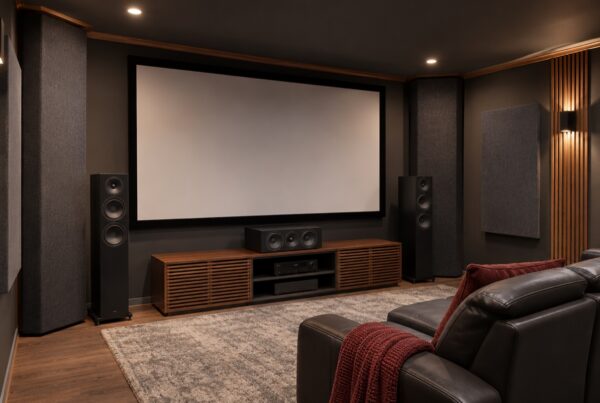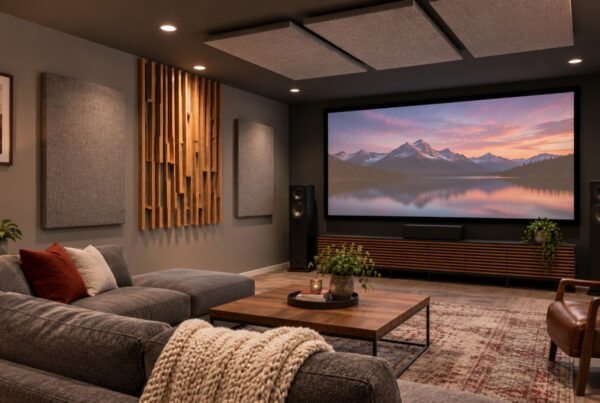


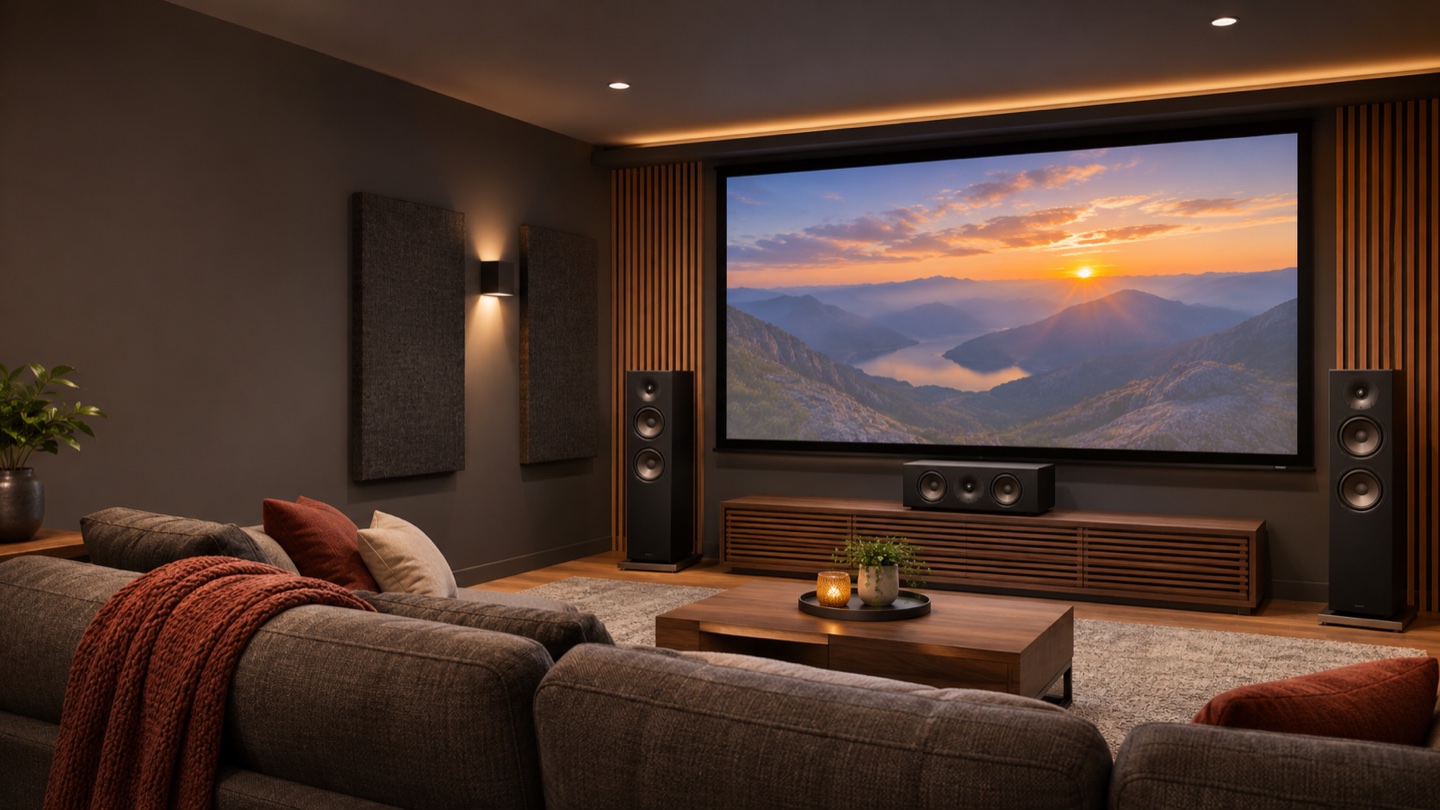
Trace unclear speech through the source, center speaker, receiver settings, listening seats, and room before changing the system.
Quick Answer
If home theater dialogue is hard to understand, first check that the center channel is connected, unobstructed, aimed toward the seats, and configured correctly. Then compare more than one program and seat. Source mixing, speaker behavior, receiver settings, playback level, room reflections, and listening position can all contribute. Room treatment may help when reflections or decay are part of the problem, but it will not correct every source, speaker, or setup issue. Diagnose the system and the room together before buying panels.
Why speech can disappear under music and effects
You press volume up because a character’s words are difficult to follow. The next action scene becomes too loud, so you turn it down and miss the next line again. That experience is frustrating, especially when the theater sounds impressive during effects but tiring during conversation.
There is not one universal dialogue fix. Film mixes vary, playback devices use different dynamic-range and dialogue features, and a center speaker can be blocked, aimed away from the audience, or working with settings that do not suit the room. Reflections can also blur speech, while bass or loud effects mask details. A useful diagnosis separates these possibilities instead of treating “unclear dialogue” as proof that you need a new speaker or a wall full of panels.
Online home-theater discussions show people trying center-channel level changes, crossover adjustments, room correction, speaker upgrades, and treatment. Those posts are self-reported anecdotes, not controlled comparisons. Their practical lesson is that people often change several things at once and then cannot tell which change mattered. Work in a fixed order and write down what you test.
This guide covers a cautious way to check dialogue, the room conditions that can affect it, and when an acoustic assessment is a sensible next step. If the wider room and bass problem matters too, see the home theater acoustic design and treatment guide.
Start with the simple checks
Before changing acoustics, make sure sound is reaching the center speaker as intended. Confirm the speaker is connected, the receiver recognizes the channel, and no cable or processing setting has changed. Check more than one film or episode. If one title is difficult and another is clear, the soundtrack mix or playback format may be part of the experience.
Next, confirm the center channel has a clear path to the listening seats. A speaker tucked behind a cabinet lip, placed deep in a cubby, or aimed at knees instead of listeners can lose clarity off axis. Objects in front of a speaker can also interfere with its sound. Make a small position or angle change and listen again before making a permanent change.
Finally, review receiver settings and calibration. Verify the intended speaker layout and that the center channel is not accidentally disabled, misidentified, or routed in an unexpected way. If room correction was recently rerun, compare the current settings with the prior configuration if you have notes. Do not increase channel level repeatedly without tracking the change. A level boost can make speech louder while also changing the balance of the mix.
A fast listening log
Use a familiar scene with ordinary dialogue, not only an action sequence. For each trial, record:
- The title and playback device or app.
- Which seats sound unclear.
- Whether the center speaker has a clear path and is aimed toward those seats.
- The receiver’s current channel, crossover, and dynamic-range settings.
- What one adjustment you made and what changed.
Keep playback at a comfortable level. If dialogue becomes intelligible only when the system is uncomfortably loud, note that as a separate issue rather than treating more volume as the answer.
The center speaker matters, but placement and coverage matter too
The center channel commonly carries on-screen dialogue in surround mixes. Its model, orientation, mounting height, location relative to the screen, and listening angle all affect what reaches a seat. A well-regarded speaker can still sound unclear if its output is blocked or if a listener sits outside its useful coverage.
Look at the speaker from the seats that matter. Is the front edge flush with the shelf, or set back behind a reflective surface? Is the speaker angled toward the main seats? Are the seats spread so widely that listeners at the edges hear a different part of the speaker’s response? If the center is mounted above or below the screen, the angle to listeners may be steep. Check the manufacturer’s setup notes before changing orientation or adding a stand.
Dolby’s general speaker setup guidance identifies the center speaker as the primary dialogue channel and recommends positioning it near the display and directing sound toward listeners. That is a starting point, not a substitute for the specific speaker manual, screen geometry, or room layout. An acoustically transparent projection screen also changes what is possible because speakers may sit behind the screen; a conventional display usually does not.
Do not assume that one angle, crossover, or speaker type fits every system. Some center designs use driver arrangements that behave differently as listeners move off-axis. Receiver calibration may set levels and delays, but the result should still be checked at more than one seat. If only the far-left seat sounds unclear, the issue may be coverage or geometry rather than a room-wide reflection problem.
Source mix, dynamic range, and playback processing
A movie soundtrack can contain a broad gap between quiet dialogue and loud effects by design. Some programs have different dialogue balance from others. Streaming services, disc players, televisions, and AV receivers can also apply their own format conversion, normalization, night mode, or dynamic-range control. These features may help in some listening situations, but they change playback and should be evaluated deliberately.
Compare several sources before assuming that the room causes every problem. If dialogue is clear on a disc but unclear through one streaming app, check the app, audio output format, and receiver input. If the issue occurs on many sources and across several seats, the system setup or room becomes more plausible. If only one listener struggles, consider hearing, seating angle, and volume tolerance as part of the picture; acoustic treatment is not a substitute for individual hearing care.
If you use a dialogue enhancement or dynamic-range feature, change one setting at a time. Listen to the same passage and then return to another program. A mode that makes one film easier to follow may also change music, effects, or bass. There is no need to chase a setting that produces an unnatural balance for the whole library.
How reflections can blur speech
When sound from the speaker reaches a listener directly and then arrives again after reflecting from a hard wall, floor, ceiling, cabinet, or table, the delayed copy can change the sound’s clarity. The effect depends on the reflection’s timing, level, direction, and frequency content. A room with many strong, closely spaced reflections may make speech seem smeared or hollow, even if the center speaker itself is functioning.
Begin with the geometry around the center and front seats. A large hard coffee table can reflect sound toward listeners. A bare floor between speakers and seats may contribute to early reflections. A center speaker inside a shelf can interact with the shelf surfaces. A reflective side wall close to one seat may affect one side of the row differently from the other. These conditions deserve inspection, but a single clap test cannot identify the frequency range or exact cause.
Treatment may reduce selected reflections when the material, coverage, and placement fit the problem. A rug can affect floor reflections; an absorber can reduce reflections over part of the spectrum; a diffuser can scatter sound rather than simply absorb it. Thick absorbers, thin panels, curtains, and furniture are not interchangeable. The acoustic panels guide explains why a panel’s thickness and placement matter and why “add panels” is not a complete design.
Room treatment also does not fix a bad mix, a damaged speaker, a blocked center channel, incorrect routing, or a system that has not been calibrated for the current seating. It changes sound inside the room; sound isolation addresses transmission through walls and doors. Keep those goals separate.
A useful order for troubleshooting
1. Confirm the same content and format
Use a familiar scene from a known source. Note the device, app, audio track, and receiver input. Switch to another title. This helps separate a title-specific mix or stream setting from a room-wide pattern.
2. Check the center channel’s path
Look for obstruction, a recessed position, an edge or shelf directly in front of the speaker, and whether the speaker points toward the seats. Check the wiring and receiver layout. Do not take a speaker apart or make changes that could damage it.
3. Review level, crossover, and processing one setting at a time
Record current settings. If you adjust center level, do it in a modest step and compare at a matched comfortable volume. If you change crossover or dynamic-range control, change only one variable and recheck the same scene. Restore the previous setting if the result is less natural.
4. Compare seats and room conditions
Listen at the primary seat and a seat toward each side of the row. If clarity changes sharply with position, note seat angle, distance, nearby reflective surfaces, and whether the speaker’s coverage reaches that seat. If all seats have a similar issue, continue checking source, configuration, and room behavior.
5. Decide whether the evidence points to room treatment
If multiple sources have the same blurred quality, the center channel is operating correctly, and reflections or decay are obvious around the seating area, a room-focused assessment can help decide whether treatment is relevant. Gather the room dimensions, seat and speaker positions, construction surfaces, and the specific scenes or symptoms you notice. The Free Room Analysis information describes the next conversation with Acoustic Fields; later design or product scope should be confirmed separately.
Common fixes that can backfire
| Tempting response | Why it may not solve the issue | Better first check |
|---|---|---|
| Turn the center up several steps | It raises speech and other center-channel content, and may disturb the overall mix balance | Verify source, routing, aim, calibration, and listening level |
| Buy a new center speaker immediately | The current speaker may be blocked, mis-aimed, or outside its useful coverage at some seats | Check path, orientation, and off-axis listening positions |
| Cover every front wall with thin foam | It may absorb upper frequencies more than lower ones and leave the room unbalanced | Identify which reflections are troublesome and what frequency range is involved |
| Re-run room correction repeatedly | Different measurements or settings can change several variables without identifying the cause | Save the current settings and compare one intentional adjustment at a time |
| Treat one movie as proof | Soundtrack mixes and playback formats vary | Compare multiple familiar titles and sources |
Questions people ask
Should I always turn up the center channel?
No. A modest adjustment can be one diagnostic option if the center is correctly routed and the rest of the setup is understood. It is not a universal cure. Check content, speaker aim, receiver calibration, and the listening position before making the change permanent.
Can acoustic panels make dialogue clearer?
They can help when strong reflections or decay are contributing to speech blur. The result depends on the room and treatment design. Panels do not correct source-mix issues, bad wiring, blocked speakers, or every directivity problem.
Why is dialogue hard to hear only in some seats?
The center speaker’s angle and coverage, distances to room surfaces, seat location, and local reflections can vary across a row. Test the seats separately and describe the pattern instead of averaging them into “the room sounds bad.”
Why are voices clear on one movie and not another?
Soundtracks can differ in dialogue level, dynamic range, mix balance, and playback format. Compare more than one title and verify the device’s audio output before deciding that the room is responsible.
Will a room analysis require me to buy treatment?
The initial Room Analysis is an opportunity to discuss the room and the sound problem. It does not mean that a particular product or paid project is automatically appropriate. Confirm any later design or product scope with Acoustic Fields.
A practical next step
Write down the titles and seats where dialogue is difficult, the current center-speaker location, and any settings you have changed. Check the speaker path and configuration before buying more equipment. If the problem appears across sources and seats or reflections are part of what you hear, request a Free Room Analysis to discuss the room, layout, and goals with Dennis Foley.
Separate an equipment issue from a room issue
Listen for a repeatable pattern. If dialogue is quiet on one streaming title but clear on a disc or another program, compare the source and playback settings first. If the center channel sounds weak on every title, inspect its connection, level, crossover, and physical condition. If speech is clear at the main seat but blurred at the side seats, note the seating angle and speaker coverage. If speech sounds smeared at all seats along with a long or splashy decay, room reflections may be contributing.
Change only one variable at a time. Return to the same scene and playback level, write down the adjustment, and compare. A center-channel level increase can be a useful diagnostic, but it does not establish that the original problem was acoustic. The same is true of a temporary blanket or panel: a change in sound is useful information, but it does not by itself identify the right permanent treatment or prove the cause.
Keep safety and access in mind when moving a speaker or furniture. Follow the manufacturer’s installation advice, keep ventilation and service access clear, and do not block a speaker with soft furnishings. If the system is correctly configured but a consistent room pattern remains, include that evidence in a room-analysis conversation. A short record of what changed and what did not will make the next discussion more specific than a general request to “make dialogue clearer.”
About Dennis Foley
Dennis Foley is Acoustic Fields’ Chief Acoustics Engineer. He is self-taught, has worked in acoustics since 2006, and designed the company’s acoustic foam. His recommendations start with the room, its dimensions, the sound problem, and the customer’s goals.
Read more about Dennis and Acoustic Fields · Dennis Foley on LinkedIn
Start with your room
Describe the room, the seats that matter, and the sound you want to improve. Dennis can discuss the room and help identify an appropriate next step.