

Placement depends on the room behavior, absorber design, subwoofer locations, and the seats the theater needs to serve.
Quick Answer
Bass absorbers are placed according to the low-frequency behavior of the room, the absorber’s design, and the seats and subwoofer locations that matter. Corners are common places to evaluate because they meet multiple room boundaries, but “put traps in every corner” is not a complete prescription. Large porous absorbers, tuned resonant devices, and thin decorative panels behave differently. Identify the frequencies and seats involved, consider placement options, and recheck the room after each change.
Why there is no universal bass-trap location
The phrase “bass absorber” covers products and constructions with different dimensions, mechanisms, and frequency ranges. A large porous absorber is not interchangeable with a shallow decorative panel or a tuned resonant device. Their response depends on size, material, depth, air gap, installation, surface area, and location in the room.
People often look for one clear answer: front corners, rear corners, behind the subwoofer, or behind the seats. Online discussions reflect that uncertainty. Some theater owners describe trying corner absorbers; others consider ceiling soffits, risers, or adding a second subwoofer. Those are personal reports, not proof that a location will work in a different room.
Start with the reason you are considering bass absorbers. Is a note ringing too long? Does bass boom across much of the seating area? Does one seat lose a frequency that is strong elsewhere? Does the subwoofer sound weak even though the receiver is set up correctly? Those problems may involve room decay, spatial peaks and dips, system integration, or a combination. A product and placement should follow the question.
How low-frequency behavior relates to room boundaries
At low frequencies, room dimensions and boundaries create patterns of pressure and motion. A room mode can produce stronger response in some locations and weaker response in others. Corners are often considered because multiple boundaries meet and low-frequency pressure may be significant there for some modes. That makes corners reasonable locations to evaluate, not guaranteed universal locations for every device.
The room’s front-to-back length, width, height, openings, construction, and seating positions all influence the pattern. The subwoofer excites the room from its own location. The listener hears a result shaped by both source and seat. Treating one corner may reduce energy or decay in a relevant range, but it may not remove a deep null at the sofa or even out every seat.
This is why placement advice should name the objective. Are you trying to reduce a measured resonance, shorten low-frequency decay, smooth a multi-seat response, or address a specific audible boom? A setup that makes bass seem quieter at one point can leave other positions unchanged or worse. Do not infer overall success from a single seat.
How low-frequency decay can mask dialogue
Dennis Foley describes two parts of bass buildup that can obscure speech as “mudd” and “soup.” In this shorthand, “mudd” is the strong low-frequency fundamental of an impact such as a crash or explosion; “soup” is the lingering low-frequency tail after that impact. If the room’s low-frequency energy decays too slowly, that tail can overlap the next line and make dialogue harder to follow. Listeners may find themselves asking a neighbor what was said. This is a useful listening description, not a separate acoustic measurement or proof that bass decay is the only cause of unclear dialogue.
The goal is not simply to turn down bass. It is to consider attack and decay across the audible range so low-frequency energy does not linger out of balance with speech and other channels. This deserves particular attention in small theaters, where several full-range speakers at different locations can excite the room in different ways. Bass absorber location is therefore one part of a room-and-system assessment; consider it alongside speaker and subwoofer positions, seating, crossover and alignment, and decay behavior at the seats that matter.
Porous absorbers and tuned absorbers behave differently
Porous broadband absorbers
Porous materials dissipate sound through movement within the absorber. Their low-frequency effectiveness generally depends on having enough depth and suitable placement. Greater thickness and an air gap can change the frequency range affected, but these details vary by product and installation. A small thin panel may be useful for some mid- or high-frequency reflections while having limited effect on deep bass.
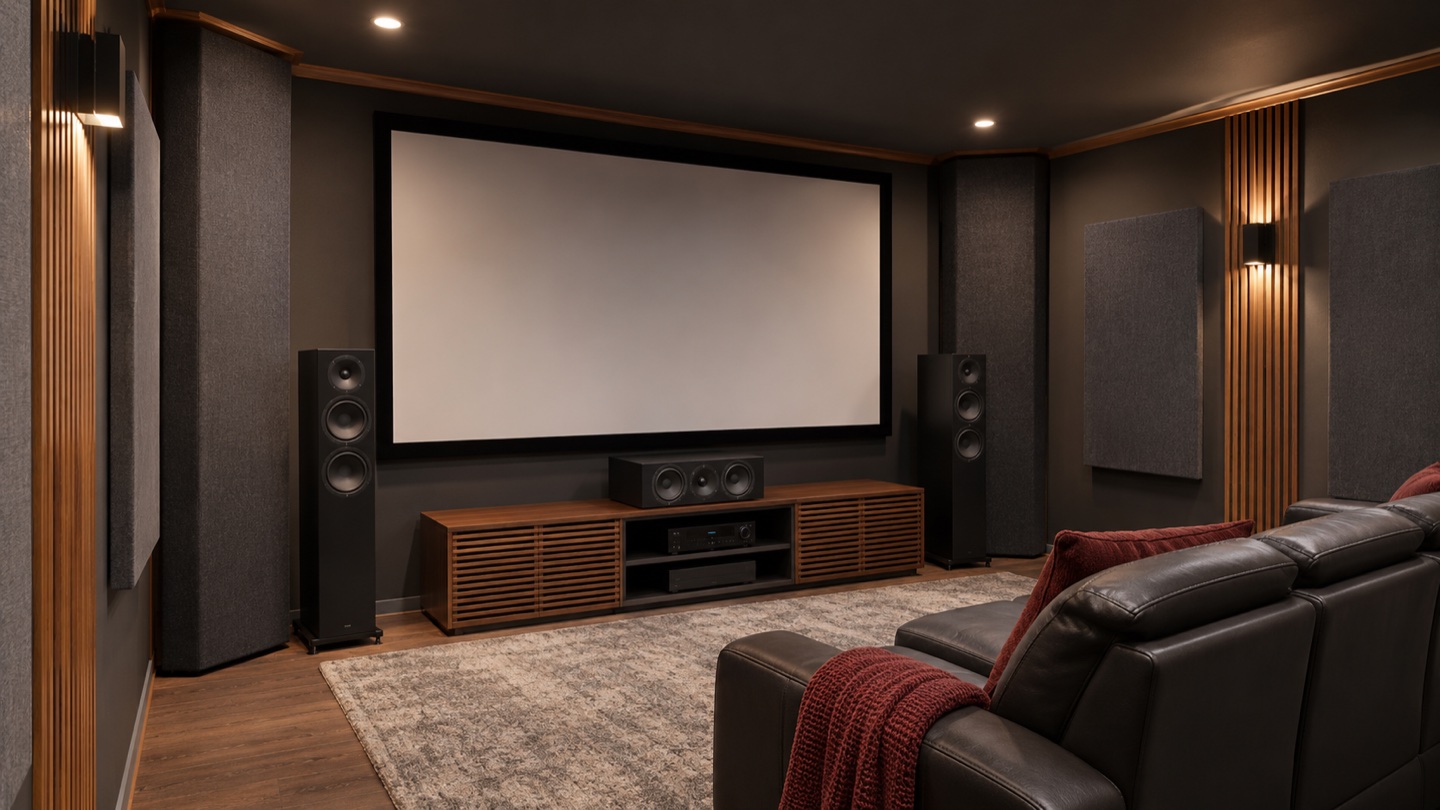
Corners and boundaries can be useful places to consider large absorbers, especially where the room can accommodate their depth. A panel mounted across a corner can leave an air space behind it, but whether that construction suits the room depends on the absorber’s properties and the target problem. Product specifications and test conditions matter; do not translate a single manufacturer’s rating into a guarantee for your theater.
Resonant or tuned absorbers
A resonant absorber is designed to address a narrower frequency range or behavior. Its tuning, construction, location, and relationship to the target frequency matter. A tuned device cannot simply be put anywhere because the room has bass problems. If the issue is at a frequency outside the device’s useful range, or if the placement does not couple to the relevant sound field, the result may be limited.
Some designs interact with pressure regions at boundaries; others use different mechanisms. Ask what frequency range the device is designed for, how it is tested, what installation is assumed, and what evidence will be used to decide where it goes. Avoid assuming that the word “bass trap” means it absorbs all bass equally.
Include space, appearance, and access in the plan
The location that looks acoustically promising still has to work in the theater. A deep absorber may reduce usable floor area, cover an outlet or door, conflict with a screen, or block a walkway. A ceiling treatment may compete with lighting, sprinklers, access panels, or overhead speakers. In a shared media room, a visible object may also be unacceptable even if there is room for it.
List the places where a device could physically fit, the depth you can accept, and whether construction is still open. Those constraints do not change the room physics, but they change which options are practical. If the room is under renovation, communicate that early; if it is finished, show the existing surfaces and openings. Do not commit to an expensive or permanent change based on a generic diagram.
Budget should be compared against the goal, not only the unit price. A treatment may require several devices, mounting, fabric, custom carpentry, or professional design. The scope and shipping details should be confirmed for the specific project and location. No generic number of absorbers or standard kit is a reliable substitute for that discussion.
Thin panels and decorative treatment
A thin wall panel may be attractive and can reduce some higher-frequency reflections. That does not make it a bass absorber for deep frequencies. Covering a room with thin treatment can alter treble balance without addressing low-frequency storage or seat-to-seat changes. Use panels according to their tested behavior, not their label or appearance.
The Acoustic Panels guide provides broader context on how panel construction and thickness relate to treatment choices. Acoustic Fields’ home theater design guide explains why the room, seating, and system need to be considered together.
CEDIA/CTA-RP22 also distinguishes balanced room treatment from covering large areas with thin absorbers. Its immersive-audio design practice is general industry guidance, not a product specification or a claim that Acoustic Fields follows a certification program.
Placement questions to answer before buying
Which seats are the priority?
Mark the seats on a floor plan. If a theater has two rows, write down whether the front row, rear row, or both need acceptable bass. A single-sub setup optimized at the center seat may not represent the rear corners or aisle seats. The goal affects what counts as a good placement.
What does the problem sound like?
Describe the symptom by frequency range if known, seat, and content. “There is too much bass near the back wall” is more useful than “the bass is bad.” If a particular note booms across several seats, that points to a different investigation from one frequency disappearing only at the center seat.
What has already been changed?
Record subwoofer location, crossover, level, phase or delay, receiver calibration profile, and any EQ. Include recent seat moves or furniture changes. If the problem appeared after a system change, recheck the setup before adding treatment. Several small changes made together can make cause and effect impossible to separate.
Is the objective decay, level, or spatial consistency?
Bass absorbers can be discussed in terms of how they affect low-frequency energy over time, but a seat-specific peak or dip also depends on spatial interference. These are related but not identical goals. If the main issue is a response null, absorber placement alone may not correct it. Subwoofer locations, seat placement, phase, delay, and bass management may need evaluation too.
A practical placement workflow
1. Sketch the actual room
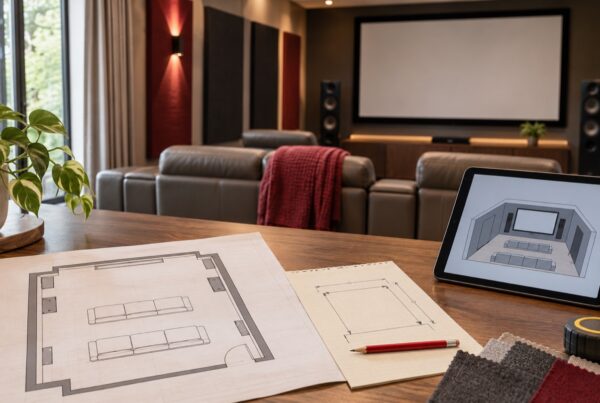
Include internal dimensions, ceiling height, doors, openings, closets, screen wall, seats, risers, subwoofer positions, and large furniture. Mark where the listener hears too much or too little bass. A sketch is more useful than a shopping cart filled from a generic room diagram.
2. Stabilize the receiver and subwoofer settings
Record the existing settings. Verify the subwoofer is enabled, the speaker layout and crossover are as intended, and no calibration profile has changed. Do not move a sub and change EQ at the same time. A placement test is most useful when other settings remain fixed.
3. Listen or measure at every important seat
Use the same content or signal at a comfortable level. If you make measurements, use a repeatable microphone position and document the settings. A single measurement may show what happens at one point, but a multi-seat question needs observations from multiple seats.
4. Identify candidate zones, not a universal answer
Room corners, wall-ceiling junctions, and other boundary areas may be candidates for certain absorbers. The best available location can be constrained by doors, walkways, windows, screen access, decor, or construction. Consider the absorber’s depth and coverage before deciding that a particular spot is practical.
5. Change one thing and check the same seats
After placement, compare the same content, seats, and receiver settings. Record whether the boom, decay, or seat variation changed. If one seat improves while another worsens, keep both observations. Repeated adjustment without a record can lead to a placement that seems better only because the listening condition changed.
6. Revisit the overall system goal
If the room is meant for a group, define an acceptable response over that area rather than chasing a perfect reading at one point. If only one seat matters, state that priority. In either case, bass treatment and subwoofer integration should be considered as parts of one room plan.
Bass absorption compared with other changes
| Change | Primary question it may help answer | Important limit |
|---|---|---|
| Move a seat | Is the listener located in a bass peak or dip? | May improve one place while reducing convenience or changing another seat |
| Move a subwoofer | Does source location change the modal response? | Each location can produce a different pattern; test the listening zone |
| Add a second subwoofer | Can the system create a smoother multi-seat field? | Requires suitable locations and integration; not a guaranteed cure |
| Use EQ | Can measured peaks be reduced or average response shaped? | Deep nulls may not be safely or effectively filled |
| Add porous bass absorption | Is low-frequency energy storage or decay part of the issue? | Product depth, coverage, and location set practical limits |
| Use a tuned absorber | Is there a target frequency suitable for this device? | Must match the room behavior, tuning, and installation |
| Add thin panels | Are some mid/high reflections part of the problem? | Do not assume they provide deep-bass control |
For a room-specific discussion, the Free Room Analysis page explains how to contact Acoustic Fields. Confirm the scope of any later design, products, or installation separately.
Common placement mistakes
- Putting a trap behind the sub by default. That location may not match the problem frequency or the treatment’s mechanism.
- Buying a fixed number for each corner. Room size and bass behavior are not the only variables; seating and system locations matter.
- Covering only visible wall sections with thin panels and calling the room bass-treated. Thin decorative products and substantial low-frequency absorbers serve different functions.
- Adding absorption to solve every seat null. A deep cancellation may require a different source or seat strategy.
- Ignoring the crossover region. A weak response around the sub-to-speaker transition may be related to integration rather than room absorption alone.
- Changing several variables before listening again. Keep a record and isolate the effect of a change.
Frequently asked questions
Should bass absorbers go in all four corners?
Not automatically. Corners are common candidate zones, but the number and location depend on the room, target frequency, absorber design, seating, and available space.
Should bass traps sit behind the subwoofer?
There is no universal rule. The subwoofer’s position affects the room response, but the best absorber location depends on its design and the measured or audible problem.
Can a bass absorber fix a weak subwoofer?
Not necessarily. First distinguish a seat-specific cancellation from low output, a system setting, crossover integration, or equipment problem. Treatment cannot replace a correctly working system.
Are two subwoofers better than bass traps?
They address different aspects and may be used together. Multiple subs can create more options for smoothing response across seats; bass absorption can affect room energy and decay. Which is relevant depends on the room and goal.
How thick should a home theater bass absorber be?
There is no single thickness that suits every frequency or room. Evaluate the device’s test data, intended frequency range, mounting condition, usable wall area, and the room evidence.
The useful next step
Before ordering, mark the seats and subwoofer positions and describe what bass does at each location. Gather room dimensions, current settings, and any trustworthy measurements. If the cause remains unclear, request a Free Room Analysis to discuss the room before choosing absorber locations or products.
Document the room before installing anything
Start with a top-down sketch and a side view if the room has a stage, soffit, riser, or sloped ceiling. Mark doors, openings, built-ins, screens, speaker locations, equipment, and the full seating area. Include approximate room dimensions and note which walls are shared with other spaces. Those details can change which surfaces are accessible and whether installation depth or weight is a constraint.
Then write down what the bass does, not just where you think a device should go. Does one seat have a strong peak, a weak note, or a long decay? Is the pattern present with every subwoofer or only one configuration? Do not use a single listening impression to select a precise absorber location. If you can measure, preserve the raw traces and the test conditions: source, microphone position, level, subwoofer configuration, crossover, and correction settings. Measurements are most useful when they answer a clear question and can be repeated.
Check the product documentation for the intended frequency range and mounting conditions. A label such as “bass trap” does not show how much absorption occurs at a particular frequency in your room. Also confirm whether installation is compatible with the wall, ceiling, fire-safety requirements, and access needs. If those details are uncertain, pause before drilling or covering a service area. A room-specific plan can weigh the acoustic target against the usable space and the practical limits of the theater.
About Dennis Foley
Dennis Foley is Acoustic Fields’ Chief Acoustics Engineer. He is self-taught, has worked in acoustics since 2006, and designed the company’s acoustic foam. His recommendations start with the room, its dimensions, the sound problem, and the customer’s goals.
Read more about Dennis and Acoustic Fields · Dennis Foley on LinkedIn
Start with your room
Describe the room, the seats that matter, and the sound you want to improve. Dennis can discuss the room and help identify an appropriate next step.