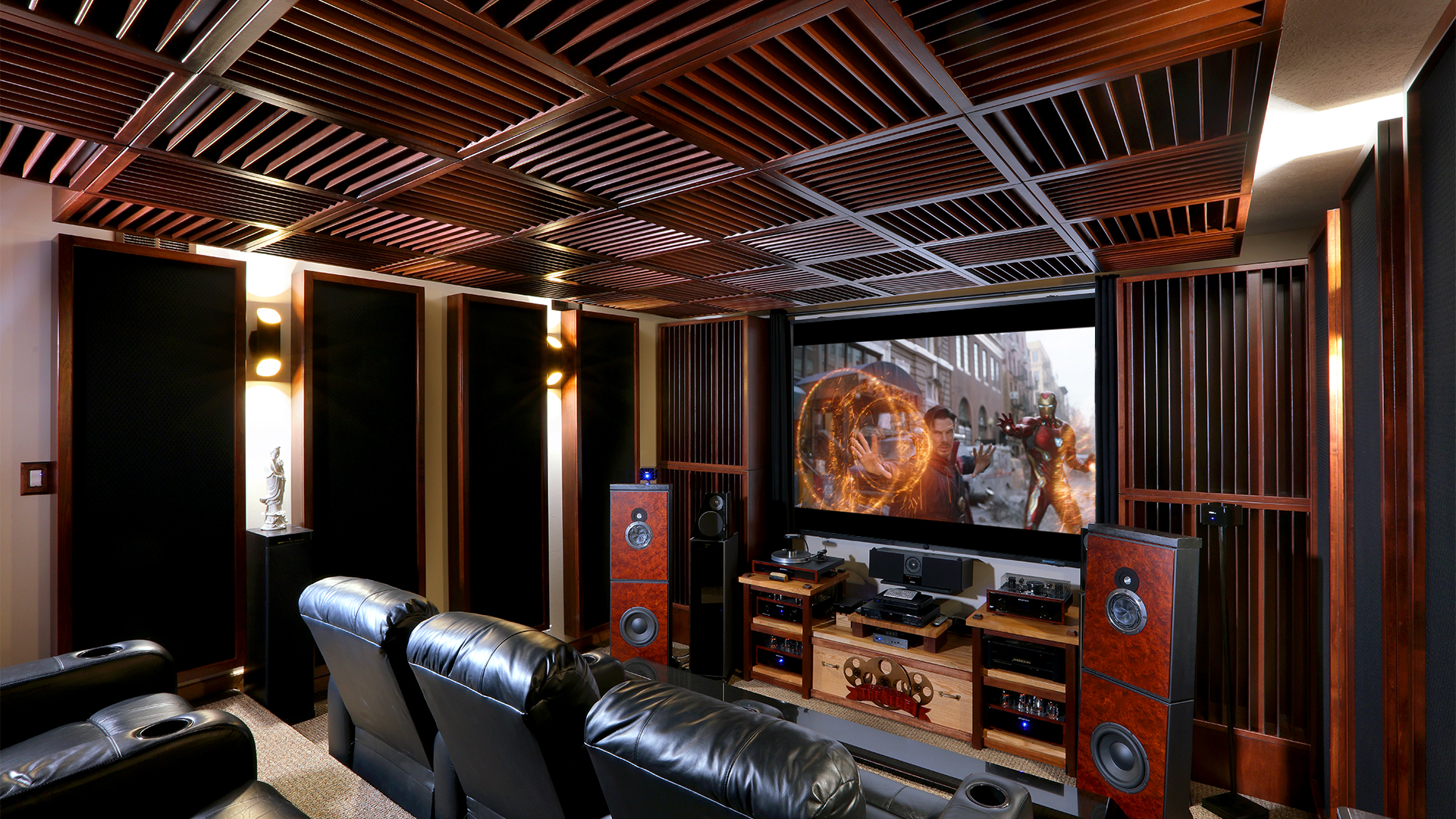
If you are looking for a home theater acoustic design service, start by describing the room and the sound you want to improve. At Acoustic Fields, we consider the room’s size, surfaces, speakers, seating, and intended use before discussing possible next steps for clearer dialogue, more consistent bass, and comfortable playback.
Home theater imagery from the existing Acoustic Fields service page.
Quick Answer
Home theater acoustic design is the process of understanding how the room, speaker and subwoofer positions, seating, and surfaces affect the sound—and then choosing room-specific steps. If dialogue is hard to understand, bass booms in one seat, or the room echoes, adding panels at random may not address the cause. A free Room Analysis with Dennis Foley is a practical first step to discuss the room and its goals before deciding whether treatment, layout changes, products, design help, or another adjustment makes sense.
Start with what you hear
You may be enjoying the picture while struggling with the soundtrack. Dialogue gets buried. The subwoofer feels powerful in one seat and weak in another. Reflections make the room sound bright or echoey, and turning up the volume makes listening less comfortable instead of more involving.
Those symptoms do not point to one automatic fix. A speaker can be aimed or configured poorly; a seat can sit in a bass peak or cancellation; reflective boundaries can blur speech; and room correction may not address every physical issue. The useful first question is: what does the sound do at the seats you actually use?
Center-speaker position and aim, calibration, channel balance, nearby reflections, source mix, and hearing can all affect speech. Check the system and the room before assuming the speaker or treatment alone is at fault.
Bass booms in one seat
Low-frequency sound changes with position. Seating, boundaries, subwoofer location, crossover, and room dimensions may combine to create a peak at one seat and a dip a few feet away.
The room echoes
Hard surfaces and bare areas can create audible reflections. Rugs, furnishings, absorbers, and diffusers do different things; a balanced plan matters more than covering every wall.
Sound turns harsh at volume
Reflections can contribute, but also check the source, speaker behavior and aim, receiver settings, and room rattles. A symptom alone does not identify the cause.
The subwoofer sounds weak
Weak output can reflect setup or integration issues—or a seat-specific cancellation that more level will not fix. Review signal path, placement, crossover, and phase/delay before adding output.
What a room analysis considers
We need more than an equipment list to understand a theater. The room’s size and volume, speakers, low-frequency sources, surfaces, intended use, seating positions, and the sound problem all provide useful context.
Room dimensions, openings, and unusual shapes
Speaker and subwoofer locations and models, if known
Main seat, additional seats, rows, and boundary distances
Walls, ceiling, floor, windows, doors, furniture, and existing treatment
What sounds wrong, when it occurs, and what can or cannot change
These factors align with those named in the Room Analysis information on the site. A photo or graph can add context, but one picture or measurement is not the whole room diagnosis.
Music Environment Part II, as labeled in the existing project portfolio.
Treatment, sound isolation, and system setup are different
These areas interact but are not interchangeable. Panels may change reflections inside the room; they do not automatically soundproof a wall. Electronic calibration can correct some response issues, but it cannot change the room’s construction or make every seat behave the same. If transmission is your main concern, see sound isolation and noise transmission control. For treatment basics, see our acoustic panels guide.
A room-specific design process
1. Explain the room
Share the intended use, dimensions, seating, system, and what you hear. If you are building or renovating, say which decisions remain open.
2. Consider room and system
Discuss how room size and surfaces, speakers, low-frequency sources, and listening positions may relate to the problem.
3. Discuss practical options
Depending on the room, options may include layout guidance, treatment, absorption or diffusion, bass management, products, or a combination. A home theater sound treatment consultation should account for the room, what can change, visual preferences, and your goals. We can discuss custom acoustic treatment for a home theater after those details are understood.
4. Confirm the scope
Before paid work, confirm deliverables, exclusions, installation availability, and product shipping for your location. Remote design is worldwide; installation is USA only.
Home Cinema – Dolby Atmos, as labeled in the existing project portfolio.
Plan for the seats, not one perfect spot
An immersive theater is for people, not just a microphone at one point. Tell us how many seats matter, where each row will go, and whether off-center seats need good coverage. Dolby’s speaker and seating guidance emphasizes the relationship between system layout and listeners. CEDIA’s RP22 immersive audio design practice is another planning reference.
There can be trade-offs between prioritizing one main seat and making sound more consistent for a group. A realistic plan accounts for fixed sofas, room openings, sightlines, and construction limits rather than promising identical sound everywhere. The existing Acoustic Fields project gallery includes home theater examples; each room is unique.
Frequently asked questions
Can acoustic treatment make dialogue clearer?
It can help when reflections or decay contribute to unclear speech. Center-speaker position, aiming, calibration, source mix, and hearing needs also matter. Diagnose the full system and room before choosing treatment.
Why does bass boom in one seat and disappear in another?
Room boundaries and low-frequency modes can create peaks and dips that change with position. Seating, subwoofer placement, room dimensions, and system integration can all affect the result.
Will bass absorber panels fix a weak subwoofer?
Not automatically. First distinguish low output from a seat-specific cancellation, setup issue, or masking. Placement, crossover, phase/delay, and settings may also need review.
Does acoustic treatment soundproof a home theater?
No. Treatment changes sound inside a room. Isolation addresses sound transmission through walls, ceilings, doors, and other paths.
Is Room Analysis free?
Acoustic Fields describes the Room Analysis as a free initial conversation and assessment with Dennis Foley. Confirm any later design, product, or installation scope separately.
Start with your room
If dialogue, bass, or reflections keep pulling you out of the movie, tell us what you hear and which seats matter. Share dimensions, the speaker and seating layout, photos where the form allows, and the changes you can consider. Dennis can discuss the room with you and help identify an appropriate next step.
Dennis Foley is Acoustic Fields’ Chief Acoustics Engineer. He is self-taught, has worked in acoustics since 2006, and designed the company’s acoustic foam. He helps clients understand the physics behind room sound and consider options based on the room, its dimensions, the sound problem, and the customer’s goals.