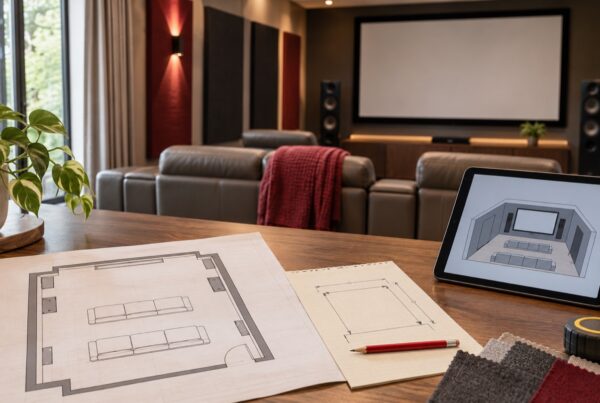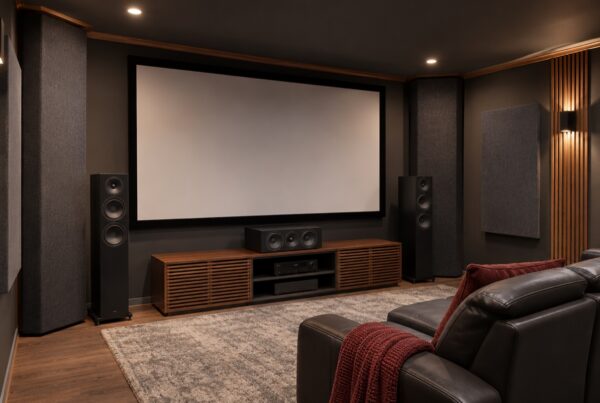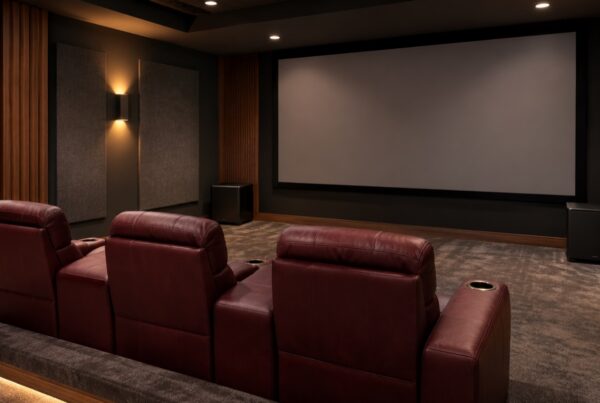


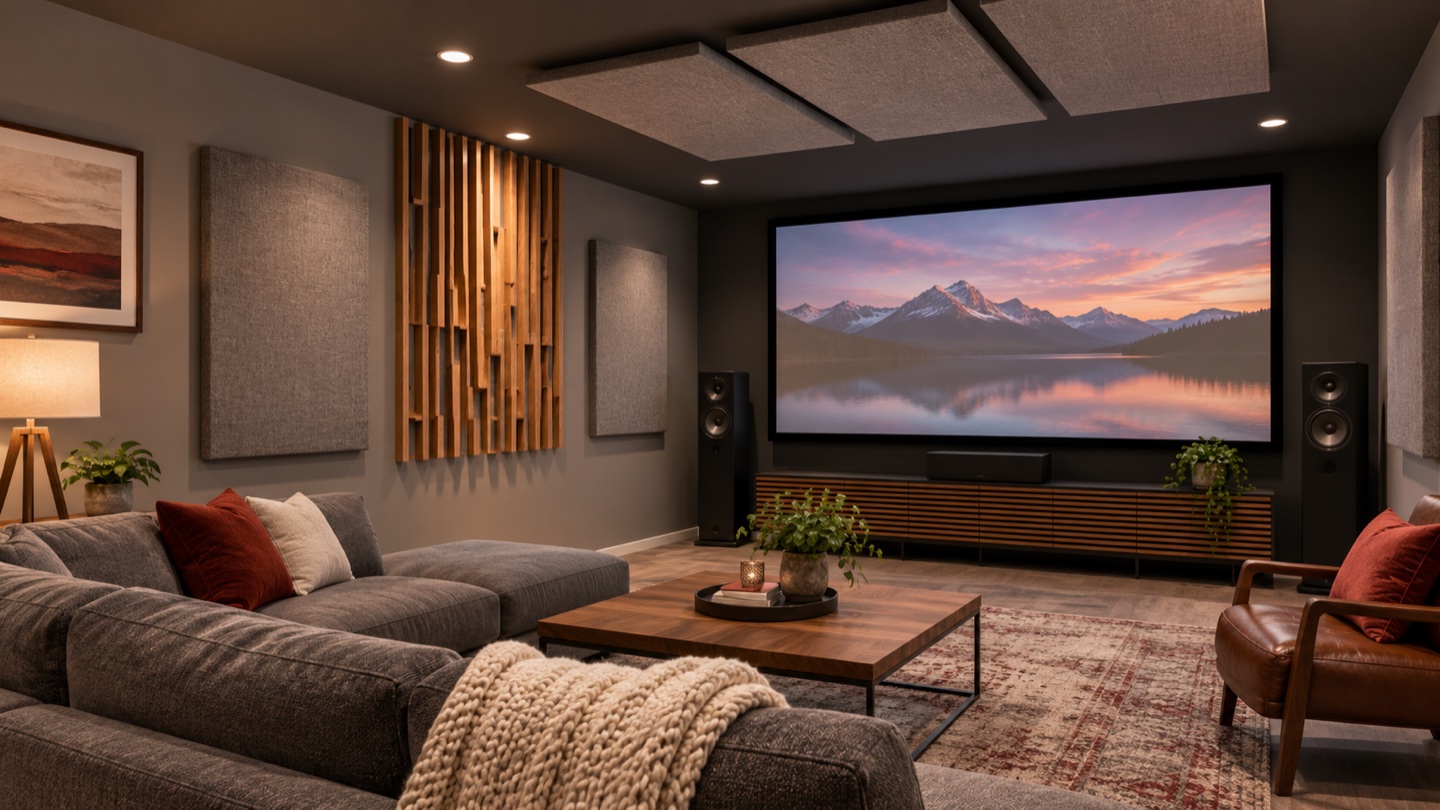
Identify the reflections and decay that matter, then choose a balanced response instead of covering the room by guesswork.
Quick Answer
To reduce echo in a home theater without making it sound dead, identify which reflections are distracting, where they come from, and which frequencies are affected before adding treatment. A rug, furniture, absorbers, or other surface changes may help in appropriate locations, but covering every wall with thin foam can absorb upper frequencies while leaving bass and lower midrange problems. A balanced room controls disruptive decay and reflections while preserving a natural sense of space. The right amount and placement depend on the room, speakers, seating, and use.
Why “more panels” is not a complete echo plan
Movie sound seems to bounce around the room, voices feel smeared, or a sharp clap leaves a lingering tail. You may want the echo gone but still want the theater to feel immersive and comfortable for conversation. Those goals can conflict if the room is treated without a clear plan.
People in home-theater forums often ask where panels should go, whether a room can become too dead, and whether thin absorbers are enough. Some describe adding carpet or curtains, others plan to cover walls and ceiling. These reports reveal real design concerns—space, appearance, cost, and uncertainty—but they are not controlled listening tests. A photo of someone else’s room does not show your room’s reflection paths or frequency balance.
The useful distinction is between reducing a specific audible problem and absorbing sound indiscriminately. A theater that has a sharp flutter between parallel walls may need a different response from one that sounds boomy or has excessive bass decay. A bare coffee table may create a reflection at a particular seat, while the whole room may have a long low-frequency tail. “Echo” is the visitor’s word; the diagnosis should get more specific.
Why too much absorption can sound unnatural
Thin absorptive materials tend to affect higher frequencies more than lower ones. If they cover a large area, the high-frequency balance may change while much of the low-frequency energy remains. The result may sound dull, closed in, or uneven rather than comfortably controlled. That is one reason that treating “echo” with whatever panel is easiest to install can disappoint.
Absorption also changes the room’s reflected sound and sense of envelopment. Some reflections are part of how a room sounds spacious. Eliminating every reflection is not the objective for every home theater. A listener may prefer a drier presentation at the front and some controlled reflected energy around or behind the audience, but exact choices depend on room goals, speaker directivity, and channel layout.
Think in terms of balance across frequency and coverage. A room with hard floors, bare side walls, glass, and a short wall-to-seat distance may need a different plan from a carpeted theater with thick seating and fabric surfaces. Furniture and audience size also change absorption. A room that sounds acceptable when empty may sound more damped when full of people.
A measured, room-specific treatment process
Step 1: Keep the system and content constant
Use one familiar title and source while you investigate. Verify that the speaker layout and receiver settings are stable. Avoid changing EQ, seat positions, and treatment on the same day without taking notes. Changing one variable at a time makes the outcome easier to interpret.
Step 2: Decide where the issue is most noticeable
Record which seats hear the echo, which speakers seem involved, and which surfaces sit between each speaker and listener. If the symptom is near one seat or one channel, note that. A room-wide treatment plan should not be assumed from a problem that occurs only at one geometry.
Step 3: Try reversible room-use changes
If the room is used for both movies and everyday conversation, note whether curtains, a rug, a throw, furniture, or open doors change the sound. These changes are diagnostic clues, not guaranteed permanent acoustic fixes. A sofa can absorb some sound and scatter other sound; a curtain’s effect depends on its material, folds, coverage, and distance from the wall.
Step 4: Consider selective treatment
If you identify strong early reflections, an absorber may be useful where it can reduce that reflection without unnecessarily changing the whole room’s balance. If flutter echo occurs between parallel surfaces, treatment or scattering on one or both surfaces may help. If bass is boomy, look at low-frequency behavior separately rather than expecting thin wall panels to solve it.
Step 5: Recheck the seats and the room’s character
After a change, replay the same content and sit in the same positions. Listen for both the original issue and new ones: excessive dullness, reduced spaciousness, unequal left-right balance, or persistent bass decay. The aim is not to win a clap test. It is to make the room work better for its actual listening use.
Step 6: Ask for help when the pattern is unclear
If the room remains echoey after basic system checks, or if your treatment options are limited by windows, doors, decor, or multiple rows, document the dimensions, surfaces, seats, and sound symptoms. Acoustic Fields’ Free Room Analysis page describes the initial conversation. Confirm any later design, products, or installation scope separately.
Treatment options at a glance
| Approach | Can be useful when | Watch for |
|---|---|---|
| Rug or soft floor covering | Floor reflections contribute between speaker and listener | A rug does not control all wall, ceiling, or low-frequency behavior |
| Curtains | Glass or a hard window area is involved and the fabric can cover it | Thin or open curtains may have limited effect; results vary with coverage |
| Absorptive panels | A particular reflection or decay issue has been identified | Thin panels over too much area may over-absorb highs and leave lows |
| Diffusive or scattering surfaces | The room needs a different reflection pattern and there is suitable distance/geometry | Decorative slats are not automatically a tested diffuser |
| Bass absorption | Low-frequency decay or buildup is part of the problem | Size, material, location, and frequency range matter; shallow products have limits |
| Speaker/seat adjustment | Geometry, aim, or proximity to a boundary contributes | A change that helps one location may affect another seat |
For product terminology and treatment trade-offs, see the Acoustic Panels guide. Product labels alone do not determine whether a treatment suits a room.
Common approaches to avoid
- Covering every wall with thin foam. This may shift the room’s tonal balance rather than address the main reflections or bass.
- Treating the ceiling without checking speaker paths and use. A ceiling cloud can be useful in some layouts, but placement needs to account for speakers, lights, screen, and the seats.
- Assuming curtains are soundproofing. Room treatment changes reflections inside a room; isolation limits sound transmission through building elements.
- Copying another theater’s panel count. Room dimensions, surfaces, speakers, listeners, and use differ.
- Evaluating only when the room is empty. Seating and people absorb and scatter sound.
- Using a clap test to select products. It is a rough listening clue, not a complete specification.
How to judge whether the room is balanced
Do not judge success only by how quickly a clap seems to disappear. A theater also needs intelligible speech, clear localization, a convincing surround field, and a comfortable sound for ordinary conversation. Listen to dialogue, sustained music, and short effects at the seats you use. If one kind of material improves but the room becomes dull for everything else, the treatment may be too broad or too concentrated in one frequency region.
Room measurements can add detail when the question is clear. An impulse response or decay view may help show when reflections arrive; frequency-dependent measurements can help distinguish bass behavior from upper-frequency reflections. But microphone position, loudspeaker placement, room noise, window and door conditions, and the analysis settings all matter. A single number cannot describe every seat or tell you which product to install without interpretation.
If two walls are hard and parallel, a simple hand clap may create a quick flutter that moves as you walk around. That clue points you toward looking at the parallel surfaces, but it does not establish how much absorption is needed or whether scattering is preferred. A repeated low-frequency note that lingers suggests another question: does that decay happen throughout the room, or mainly at one seat? Ask these questions before deciding the room needs the same treatment everywhere.
The practical target is a room that supports its use. A dedicated cinema with fixed seating and a room used for family conversation may have different priorities. Write down whether movie clarity, multi-seat consistency, music playback, aesthetics, or keeping surfaces visually simple is most important. A useful treatment plan has to address the acoustic issue and fit how the room actually operates.
Frequently asked questions
Can a home theater have too many acoustic panels?
Yes. Too much absorption, especially when it mainly affects high frequencies, can make the room sound dull or unnatural while leaving lower-frequency problems. The balance and coverage matter more than the raw count.
Will acoustic foam stop echo?
Some foam can absorb certain higher-frequency reflections, depending on its thickness and installation. It is not a universal solution for bass or every echo problem. Identify the sound issue and frequency range before choosing a material.
Should I cover the first reflection points?
Those locations can be useful to evaluate, but a reflection-point diagram is only a starting point. Speaker directivity, seat locations, room symmetry, and whether you want absorption or diffusion affect the decision.
Does a home theater need to sound completely dead?
No. A comfortable room controls distracting reflections and decay while preserving an appropriate sense of space. The desired balance depends on the room and listening preference.
Does treating echo make a room soundproof?
No. Acoustic treatment changes sound inside the room. Sound isolation addresses how sound travels through walls, floors, ceilings, doors, and other paths.
A practical next step
Identify the seats and surfaces involved, test one reversible change, and listen again at the same level. If you’re still unsure whether the room needs selective absorption, scattering, bass treatment, or a different system setup, request a Free Room Analysis and describe how the room is used.
Use a controlled listening comparison
Choose a familiar scene that includes speech, music, and a brief pause. Listen from the primary seat at a comfortable, repeatable level. Note whether the issue is a distinct slap, a lingering tail, a harsh tonal balance, or simply too much overall loudness. These impressions point to different questions, so avoid using “echo” as a catch-all label for every sound that feels bright or unclear.
If you test a temporary change, use a safe, reversible setup and alter one surface or object at a time. Keep the speakers, seat, playback level, and source material fixed. A heavy curtain can change some reflections, but it may affect only part of the frequency range and can introduce other tradeoffs. A thick rug may be useful for floor reflections in some layouts, while leaving side-wall reflections and bass behavior largely unchanged. Record exactly what moved and what you heard.
The goal is a room that supports the intended listening experience, not the smallest possible reverberation number. A theater may need some sense of space while reducing strong, distracting reflections. The right balance depends on the room dimensions, speaker directivity, screen and seating arrangement, construction, and whether the space is dedicated or shared. If the room is also used for conversation or music, say so when discussing changes. A plan that makes movie dialogue more comfortable should still respect how people use the room outside one demonstration scene.
About Dennis Foley
Dennis Foley is Acoustic Fields’ Chief Acoustics Engineer. He is self-taught, has worked in acoustics since 2006, and designed the company’s acoustic foam. His recommendations start with the room, its dimensions, the sound problem, and the customer’s goals.
Read more about Dennis and Acoustic Fields · Dennis Foley on LinkedIn
Start with your room
Describe the room, the seats that matter, and the sound you want to improve. Dennis can discuss the room and help identify an appropriate next step.