

Quick Answer
Muddy bass in a recording studio can come from low-frequency room behavior, speaker or listening-position placement, the monitoring system, or the mix itself. Compare familiar reference tracks, listen at more than one position, and check the setup before changing EQ. If bass changes sharply across the room or certain notes swell or vanish, assess the room dimensions and monitoring geometry before choosing treatment.
Why does the bass sound muddy in my recording studio?
“Muddy bass” is a useful description of what you hear, but it does not identify one cause. The low end may feel too loud, indistinct, or uneven. A kick drum and bass guitar may blur together. One note may boom while a nearby note seems weak. Sometimes a mix sounds balanced at the desk and different a few feet away.
The room is one possible cause. Low-frequency sound interacts with room boundaries and dimensions. At some positions, certain frequencies build up; at others, they can be much quieter. Monitor placement and the listening position affect what reaches your ears. The mix, speakers, subwoofer, and playback level matter too. It is possible for more than one of these factors to be involved.
People discussing studio problems online often describe exactly this uncertainty: “Is it the room, my speakers, my treatment, or my decisions?” Treat those discussions as useful symptom reports, not diagnoses. A listening impression alone cannot tell you which product or change will solve the problem.
Start with a repeatable listening check
Before moving equipment, choose two or three recordings you know well. Include a track with a steady bass line, a kick drum, and some midrange detail. Use the same listening level each time. Write down what seems wrong rather than relying on memory: Is the bass too strong everywhere? Does one note hang on? Is the kick hard to distinguish from the bass? Does the balance change when you move?
Play a familiar reference track, then a mix you are working on. Switch between them without changing the volume or playback chain. If both have a similar low-frequency problem, the monitoring environment becomes a stronger possibility. If the reference sounds clear but the mix does not, the arrangement, recording, editing, or mix may be contributing. This check is not conclusive, but it gives you a more useful starting point than adding a broad EQ cut immediately.
Also check simple settings. Confirm that left and right speakers are both playing, that polarity and connections are consistent, and that any subwoofer crossover or level setting is intentional. Disable unfamiliar room correction temporarily only if you know how to restore the original settings. Change one thing at a time and record it.
Does the bass change when I move around the room?
This is one of the most useful clues. Play a consistent bass passage at a safe, moderate level and listen from the normal mix position, then from a few nearby spots. You may notice that a bass note is strong near a wall but weak at the chair, or that the balance shifts between the front and back of the room.
Room modes are resonant patterns associated with a room’s dimensions and boundaries. At low frequencies, these patterns can produce areas of higher and lower sound pressure. A listening position near a low-pressure region can make some notes seem to disappear; a position in a strong region can make them seem exaggerated. Genelec’s monitor-placement guidance explains that room resonances and placement can significantly affect low-frequency reproduction, and that changing speaker or listener position can reduce the influence of some resonances.
Do not interpret this as proof that a particular position or treatment will fix everything. A quick walk-around test identifies variation; it does not map the room precisely. Keep notes about where the sound changes and which notes are affected. Room dimensions, construction, openings, furniture, and monitoring position all help explain what is happening.
Check monitor and listening-position placement
Small placement changes can alter what you hear. Start by confirming left-right symmetry: the two monitors should have similar relationships to nearby side walls and be aimed consistently toward the listening position. Unequal distances and different nearby surfaces can make the stereo image and tonal balance differ between channels.
Avoid putting the chair exactly at the room’s midpoint without checking how it sounds. Also avoid making a string of random moves based on a single track. Move the chair or both monitors in small, measured steps; note the original location so you can return to it. Recheck with the same reference recording at the same level after each change.
Monitor placement advice is room- and speaker-dependent. Follow the manufacturer’s guidance for the specific monitors and subwoofer. Genelec recommends considering room symmetry, monitor orientation, wall relationships, and listening position; those are useful variables to examine, but they do not replace an assessment of the specific room.
Is it the mix rather than the room?
A room can color monitoring, but not every bass issue is an acoustics problem. The mix may have overlapping bass instruments, excessive sustain, masking, inconsistent source levels, or a kick and bass part that compete. A recording may also contain room sound or resonances that were captured at the microphone. If the issue follows one track across multiple reliable monitoring systems, inspect the source and arrangement.
Use a few checks:
- Listen to the bass and kick separately, then together.
- Compare the mix at a consistent level with a reference in a similar style.
- Check whether the low end is present in mono and at quieter playback levels.
- Listen on a second known system, but do not treat a car, phone, or headphones as a calibrated reference by themselves.
- Inspect whether corrective EQ is solving one musical issue or hiding a monitoring problem.
A mix that changes on other speakers can reflect the room, speaker response, playback limits, or choices in the mix. It is rarely helpful to chase every playback device with a separate correction. The goal is a monitoring setup that lets you make repeatable decisions, then use a few other systems as translation checks.
What can measurement tell me?
If you are comfortable measuring, a calibrated measurement microphone and room-analysis software can help reveal frequency response and decay behavior at the listening position. Take measurements consistently and learn what the graphs can and cannot show. A single measurement at one point is only one view of the room; repeating measurements at nearby positions may show whether a deep dip is position-specific.
Do not buy a microphone or software solely because a forum commenter recommends it. For a home-studio owner who wants to investigate, begin with the measurement system’s setup instructions and a clear question: Are there large peaks or dips? Does the response change with position? Is low-frequency energy decaying unevenly? Measurement supports diagnosis; it does not automatically specify a treatment design.
Should I add bass traps or acoustic panels?
Only after you have a reasonable diagnosis. Absorbers differ by construction, thickness, mounting, and intended frequency range. A thin decorative or foam panel can help control some mid- and high-frequency reflections, while effective low-frequency absorption usually needs a design appropriate to the problem and placement. Sound On Sound’s studio-treatment guides distinguish ordinary thinner panels from deeper or specifically designed bass absorption. The exact performance of a product should come from its verified test information and installation conditions.
Treatment inside the room is not the same as sound isolation. Absorption and diffusion shape sound within a room. Isolation aims to reduce sound transmission to or from other spaces and usually depends on the building assembly, airtightness, mass, decoupling, and flanking paths. A wall panel should not be described as soundproofing unless there is evidence for that specific use.
Avoid the common shortcut of covering every wall with thin foam to solve bass. It may make the room less lively at higher frequencies while leaving the low-frequency problem largely intact. The room can then sound dull but still have uneven bass. Select treatment based on frequency behavior, room use, available space, and the balance you need—not on panel count alone.
| What you observe | What it may suggest | A sensible next check |
| Bass changes a lot as you move | Room-position interaction | Compare several listening positions and note dimensions |
| The same mix issue follows the mix to other systems | Arrangement, source, or mix decision | Solo and compare elements with a reference |
| Both references and mixes have similar bass imbalance | Monitoring room or speaker setup may contribute | Check monitor symmetry, placement, and room response |
| Bass sounds different between left and right | Asymmetry, settings, or channel issue | Verify levels, connections, and distances |
| Room sounds dull but bass still booms | High-frequency absorption may be excessive relative to low-frequency control | Reassess treatment types and coverage before adding more |
What information should I gather before asking for help?
Record the room’s inside width, length, and height, noting sloped ceilings or alcoves. Sketch where the desk, monitors, chair, doors, windows, and large furniture sit. Take clear photos from the corners and from the listening position. Note the monitor and subwoofer models, any correction settings, and what you have already tried.
Describe the sound in concrete terms. “Bass is bad” is less useful than “the bass guitar is strong at the desk but much quieter near the doorway; the kick and bass blur together on most tracks.” Mention whether you mix, record, master, or use the room for more than one job. Explain space and budget limits before product selection.
Acoustic Fields offers a free Room Analysis as a conversation with Dennis using room images and the customer’s goals. The analysis can help identify whether the next discussion should focus on the room, layout, treatment, or product options. It does not mean every room needs the same products or that any specific result is guaranteed.
A practical troubleshooting order
When several variables are changing at once, it becomes difficult to learn which one mattered. Use a small log. Write down the date, track, monitor level, chair position, monitor position, subwoofer setting, and what you heard. Photograph the setup before moving anything. This may feel methodical for a subjective problem, but it reduces the temptation to make a series of untracked adjustments and then guess which change helped.
Try this sequence over a few listening sessions:
- Verify the playback chain. Check that the same source and playback level are being used for each comparison. Confirm that no unintended tone control, loudness setting, or second subwoofer preset is active.
- Use familiar references. Choose professionally released tracks you know well, in a style relevant to your work. A reference is a comparison aid, not a target curve or proof that your room is accurate.
- Check more than one listening position. Move a short distance forward, back, and sideways. Note whether the same bass note becomes stronger or weaker. Return to the original position before testing the next change.
- Test monitor symmetry and location. Make one small adjustment at a time. Keep the two speakers matched relative to the room where possible, and follow the monitor maker’s setup instructions.
- Separate mix and room symptoms. Listen to a mix and a reference through the same system. If the issue follows one mix to another system, inspect the mix. If familiar tracks show similar unevenness in the room, investigate monitoring and room behavior.
- Measure or seek a room-specific review. Use measurement tools only if you can interpret their setup and limitations, or collect room details for an experienced reviewer. Do not infer a complete design from one graph or one forum post.
This is a diagnostic sequence, not a universal prescription. Some studios combine tracking and mixing, and those activities may call for different acoustic conditions. A room used for voice-over or overdubs may need to control the sound captured by a microphone; a control room needs reliable playback at the monitoring position. If both happen in the same small room, state that before planning treatment.
Why do bass notes disappear at the desk but return elsewhere?
When a note is weak at one position and fuller elsewhere, it can be a sign of a location-dependent cancellation or other room response. In plain language, the sound arriving from the loudspeaker combines with sound reflected from room boundaries. Depending on frequency and arrival timing, the combination can reinforce or reduce what reaches the listener. The pattern depends on the room and source/listener positions.
That does not mean every missing note is a room mode. A speaker may have limited output at a frequency, the source recording may not contain the note, the mix may mask it, or a crossover/subwoofer setup may contribute. Confirm that the note is present in the source and on another playback system before attributing the issue to room dimensions.
The wrong response to a suspected null is often a large boost. If the sound is being reduced by cancellation at that location, adding more energy can increase demand on the loudspeaker without creating a stable listening response. Get a better diagnosis before applying substantial low-frequency EQ or buying a product marketed as a universal fix.
What if the studio is a bedroom or converted garage?
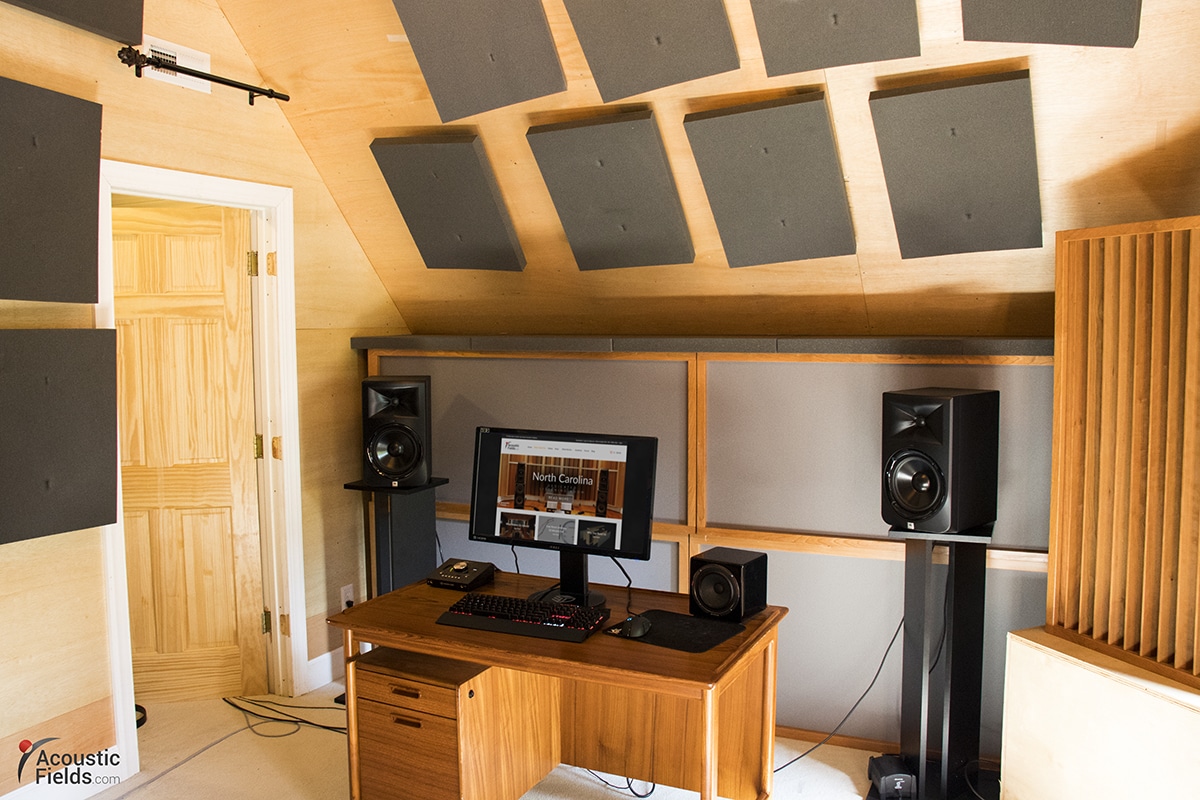
Many working rooms are chosen because they are available, not because they were designed as studios. Bedrooms, spare rooms, and converted garages can have doors, windows, sloped ceilings, storage, and asymmetrical openings that limit where the desk can go. You do not need to pretend those constraints are not there. They are part of the design brief.
Start by recording the dimensions and layout as they exist. Include the usable width and height, not just a rough floor area. Note the garage door, ceiling angle, built-in cupboards, and any large surfaces. Then state the activity: tracking vocals, recording instruments, editing, mixing, or several of these. A studio designer can only make sensible recommendations when the constraints and goals are explicit.
Do not assume a large number of panels is the answer to a small room. Panels take space; the thickness, air gap, location, and frequency range matter. A treatment plan should account for the room you actually have and the usable space you need to preserve. If a proposal would consume too much of the room, raise that concern before ordering or building anything.
When should I stop experimenting on my own?
DIY checks are useful for learning, but stop when each new change creates another uncertainty. If a chair move improves one track and worsens several others, or if a treatment purchase makes the room dull without resolving bass, return to your notes and reassess the hypothesis. Do not buy more equipment just to validate a guess.
Consider help when you have documented the room but cannot distinguish a mix issue from a monitoring issue, when multiple positions behave very differently, when you are planning a renovation, or when you need to balance tracking and mix use in one room. For a commercial studio, the cost of unreliable monitoring may affect repeated work, so a deliberate assessment can be more useful than continuing to make isolated changes.
Acoustic Fields’ free Room Analysis is intended to begin with the room and the customer’s goals, using room images and a conversation with Dennis. The next step is not automatically a product purchase: recommendations depend on the room and the issue. Review the recording studio design service and the company’s published studio reviews for context. Individual reviews describe individual experiences and should not be taken as a promise of the same result in another room.
Frequently asked questions
Can EQ fix muddy bass in a room?
EQ may help with a mix or system response in some situations, but it does not remove the room’s acoustic behavior. A deep cancellation at the listening position may not respond well to simply boosting that frequency. Check placement, monitoring, and the mix before applying large corrections.
Do bass traps make a studio lose all its bass?
Properly selected low-frequency absorption is intended to reduce uneven resonant energy, not erase musical bass. The result depends on the absorber and the room. Avoid judging a treatment only by whether the room sounds quieter in one spot.
Will thin acoustic foam stop sound from reaching another room?
Not by itself. Foam is an absorptive treatment for sound inside the room and is not a substitute for a tested isolation assembly. For noise transmission, identify the path and building constraints separately.
Should I treat the room before buying better monitors?
There is no universal order that fits every setup. First identify whether the main limitation is the room, monitor capability, placement, or workflow. Treating or replacing equipment without diagnosis can spend budget without addressing the cause.
Next step
If the bass problem changes with position, or if you cannot tell whether the room or mix is responsible, document the room and ask for a structured assessment before purchasing more panels. See the Recording Studio Design Service and learn about a free Room Analysis. For the related translation problem, continue to Why Your Mix Sounds Different on Other Speakers.
Further reading
- Genelec — Studio Monitor Placement: room modes, symmetry, monitor/listener placement, and low-frequency response.
- Sound On Sound — Studio SOS Guide to Monitoring & Acoustic Treatment: reflections, bass trapping, positioning, and treatment limitations.
- Sound On Sound — Room Improvement: absorber/diffuser distinctions and low-frequency treatment.
- Acoustic Fields — Customer Reviews: site-published studio testimonials and case descriptions; refer readers to originals rather than generalizing outcomes.
Talk through your studio’s sound problem
Share room photos, dimensions, how you use the room, and what you hear. Acoustic Fields offers a free Room Analysis with a conversation with Dennis Foley.
Request a free Room Analysis Recording Studio Design Service
About the author
Dennis Foley, Chief Acoustics Engineer
Dennis Foley is self-taught, has worked in acoustics since 2006, and designed Acoustic Fields’ acoustic foam. He helps clients understand room acoustics and discuss options for their spaces. About Dennis Foley.