

Understand room modes, seating positions, subwoofer placement, and the difference between a single-seat goal and even bass across a row.
Quick Answer
Bass changes from seat to seat because low-frequency sound interacts with room boundaries and forms patterns of stronger and weaker response. A listener can sit near a peak in one place and a dip a few feet away. Subwoofer locations, seat locations, room dimensions, crossover and delay settings, and the number of listening seats all matter. Turning up the sub may make the loud seat worse without filling a deep cancellation elsewhere. Check the room and system across the whole seating area before deciding whether placement, multiple subs, equalization, treatment, or a combination is appropriate.
One theater, several different bass experiences
In one seat, a bass note may feel heavy and linger after the soundtrack changes. Move to the next cushion and the same note becomes weak. In a second row, explosions can sound much louder than they do near the screen. These differences can make it seem as though the subwoofer is unreliable, even when the system is working.
Low-frequency sound is strongly affected by room size, boundaries, source locations, and listener positions. The sound field is not uniform at every point in a room. A receiver can adjust signals, and subwoofer placement can change the pattern, but a single listening position cannot represent every seat. The important question is whether the bass response is being evaluated for one primary listener or for a group.
Home-theater forum discussions commonly include seat-specific peaks and weak spots, placement experiments, and uncertainty about whether to turn up the subwoofer, move it, add another, or buy bass traps. These posts are useful as customer-language research; they are not controlled room measurements and cannot prescribe a solution for another theater.
If you are weighing a full-room approach, start with the Home Theater Acoustic Design and Treatment page, which explains how room use, seating, system layout, and surfaces fit into the design question.
What causes a seat-to-seat bass difference?
Room modes and boundary interaction
At low frequencies, sound waves are long relative to many room details. Reflections between walls, floor, and ceiling can reinforce or reduce particular frequencies at different positions. The resulting pattern is commonly described using room modes. At one point, pressure may be higher for a certain frequency; elsewhere it may be lower. A seat moved only a short distance can land in a different part of that pattern.
Room dimensions shape the frequencies and spatial patterns involved, but dimensions alone do not tell the full story. Openings, adjoining rooms, construction, furnishing, subwoofer position, crossover behavior, and the distribution of listeners also affect what happens. The “room mode calculator” can offer a simplified estimate for some rectangular-room conditions. It is not a measurement of the built room and does not account for every boundary or system variable.
When the response has a deep cancellation at a seat, increasing the subwoofer level often raises energy elsewhere too. Equalization is more useful for reducing some peaks than for filling a deep spatial null. If the null is caused by cancellation, additional level may use more amplifier excursion without restoring the missing sound at that position.
The subwoofer is part of the room system
A subwoofer does not produce one response independent of where it sits. Moving it changes how it excites the room’s low-frequency patterns. Placement close to a wall or in a corner can increase output at some frequencies, but that does not guarantee balanced bass at every seat. A sub in a location that sounds strong at the main seat might create an uneven pattern across a row.
The amplifier and subwoofer also need to integrate with the main speakers. Crossover frequency, phase, delay, polarity, calibration microphone locations, and the receiver’s bass-management settings can influence the combined response near the crossover. If the sub sounds weak only in a narrow region, integration may need review. If the sub sounds strong in one seat and weak at another across a broad area, spatial variation deserves attention.
Seats define the listening area
A theater is often designed for a sofa, row, or multiple rows, not just one chair. The main listening position may be the first priority, but side seats and rear rows can matter too. A plan that produces a smooth response at one point may not produce the same balance a few feet away.
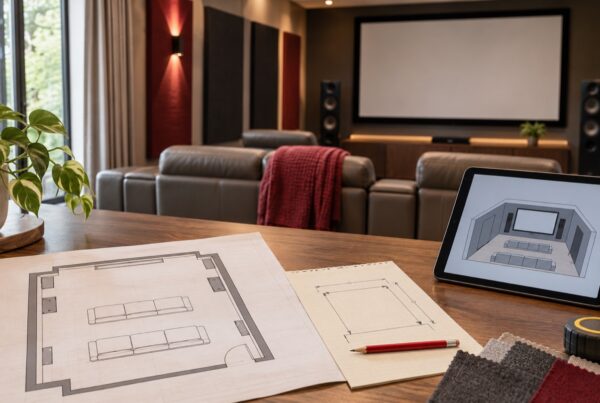
Before testing, mark the positions that matter. Count every seat you need to serve, note which are used most, and record their distances from the front, rear, and side boundaries. If the room has a riser, a door, an open archway, or seating against the rear wall, include it in the sketch. These details help explain why one seat differs from another.
What the research says about multiple subwoofers
Harman researchers Todd Welti and Allan Devantier studied configurations intended to reduce low-frequency differences across listening positions. Their multiple-subwoofer paper frames the goal as minimizing seat-to-seat frequency-response variation before equalizing the average response over the listening area. This is useful context: smoothing one seat and smoothing a seating zone are different design objectives.
The paper does not mean that every room needs two, four, or any fixed number of subwoofers. It examined particular layouts and room assumptions. A real theater has physical constraints, an actual listener distribution, system limits, and budget decisions. The locations that help in one room may not be practical or optimal in another.
Multiple subwoofers can provide more flexibility to shape the low-frequency field across a zone, but only when their locations and signals are integrated. Adding a second sub without considering timing, level, phase, and the seats involved can introduce a new problem. The relevant question is not just “How many subs?” but “What response are we trying to make more consistent, across which seats, with what placement options?”
A diagnostic routine that covers the row
1. Describe the difference in plain language
Write down which notes, scenes, or bass effects seem too strong or too weak. Identify the seat and approximate frequency range if you know it. “Bass booms in the left seat but is light in the center” is more useful than “the sub sounds bad.” Do not guess exact frequencies unless you have a repeatable test or measurement.
2. Test the seats at the same volume
Use familiar content or a controlled signal at a comfortable level. Listen from the primary seat, then move to each seat you want to support. Keep the source, master volume, and receiver settings unchanged. Avoid comparing a quiet scene in one seat with a loud effect in another.
3. Check system setup
Confirm that the subwoofer is connected, the receiver’s speaker layout is correct, bass management is enabled as intended, and crossover/delay/polarity settings have not changed unexpectedly. If room correction has multiple saved profiles, note which one is active. Do not use auto-calibration output as proof that the bass is even everywhere; the result depends on microphone positions and the correction system’s objectives.
4. Compare one placement at a time
If it is safe and practical, test a subwoofer in a few candidate locations. Recheck every relevant seat after each move. Keep a simple log of location, settings, and what changed. Do not permanently install, build into cabinetry, or move heavy equipment alone if that creates a safety risk. A small change in placement can alter the response, but there is no single universal corner rule.
5. Decide whether measurement or room analysis would help
Listening tests tell you what the room feels like; measurements can help locate peaks, dips, and seat-to-seat differences. Measurement setup also matters. A microphone position, smoothing choice, calibration file, or test signal can affect the graph. Use measurements as evidence to interpret, not as an automatic prescription.
If the same bass notes vary sharply across seats and basic setup checks do not explain it, gather room dimensions, seat positions, subwoofer locations, receiver model, crossover settings, and any graphs you already trust. Ask for guidance on the full seating area. Acoustic Fields’ Free Room Analysis page explains how to start a room discussion; confirm any later analysis or design scope separately.
Placement, EQ, treatment, or another sub?
| Option | What it may address | What it does not guarantee |
|---|---|---|
| Move the seats | A seat may move away from a strong peak or deep dip | A better response at one seat may not improve every seat |
| Move the subwoofer | Changes how the source interacts with room boundaries and modes | A new position can help some frequencies and seats but worsen others |
| Add another subwoofer | Can create more options for reducing seat-to-seat variation when properly placed and integrated | A second sub alone does not guarantee even bass |
| Apply equalization | Can reduce some broad or narrow peaks, depending on the system and measurements | EQ cannot reliably fill a deep cancellation that varies with position |
| Add bass absorption | Can reduce some low-frequency energy decay when the absorber is appropriate and sufficiently substantial | A decorative thin panel is not automatically effective at deep bass |
| Adjust crossover or delay | May improve integration between the sub and main speakers | Does not correct every room-mode pattern across multiple seats |
The Acoustic Panels guide discusses why material and frequency range matter when evaluating treatment. Bass control is not a single product category with one standard placement. Product type, depth, area, installation, and location all affect what a treatment can do.
Mistakes that keep the problem going
- Turning up the sub until the weak seat sounds stronger. The already-loud seat may become excessive, and the missing energy at a cancellation may remain missing.
- Optimizing only one seat without deciding that is the actual goal. If family or guests use other seats, include them in the plan.
- Treating a graph as self-explanatory. Check what was measured, where the microphone was, what smoothing was used, and whether the system was calibrated.
- Buying by panel count. The number of panels says little about their low-frequency behavior without their dimensions, properties, and placement.
- Changing placement, crossover, and EQ simultaneously. You will not know which change helped or hurt.
- Assuming room treatment and subwoofer integration are substitutes. They address different aspects and may need to be considered together.
Frequently asked questions
Why does bass boom in one seat and disappear in another?
Room boundaries and low-frequency modes create positions with more or less energy at particular frequencies. Moving a seat or changing a subwoofer location can alter how those patterns are heard.
Will a second subwoofer fix uneven bass?
It can offer another placement option and may help reduce variation across seats when positioned and integrated for the room. It is not a guarantee. The number and placement depend on the space, seats, and system.
Should I put a subwoofer in a corner?
A corner can increase output at some frequencies, but it may not produce balanced response across the room. Compare locations at the seats you use and consider the system’s integration requirements.
Can room correction fix a bass null?
It may reduce peaks or improve average response within the limits of the system. A deep cancellation caused by geometry often cannot be filled effectively with more electrical level. Placement and spatial strategy matter.
Do bass traps make bass even at every seat?
No single treatment guarantees that. Appropriate bass absorption can reduce low-frequency energy storage, while seat-to-seat response also depends on room geometry, sub locations, and listener locations.
Does a phone sound meter show the seat-to-seat pattern?
A phone app can help you notice a large change, but its microphone, calibration, and analysis limits matter, especially at low frequencies. Do not treat one app reading as a precise room diagnosis. A calibrated microphone and repeatable measurement procedure can provide more useful information, but graphs still need to be tied to the seats, settings, and question being evaluated.
Is the rear wall always the worst place for bass?
No. A listener near a boundary may experience different low-frequency behavior, but the exact pattern depends on the room dimensions, source locations, and frequency. “Move the couch forward” can be a reasonable experiment, not a universal prescription. Measure or listen across the actual seating plan before treating a rule of thumb as a result.
What to do next
Map the seats and note which frequencies or scenes change. Check subwoofer placement and receiver settings one variable at a time. If you want an even result across a row, say so explicitly; a single-seat target and a multi-seat target are different problems. Request a Free Room Analysis to discuss the room, seating, and bass behavior before choosing more equipment or treatment.
Make a seat map before choosing a fix
Draw a simple plan of the room and mark the screen, front speakers, subwoofers, and every seat. Give each seat a label such as A1, A2, and B1 so notes from different listening sessions can be compared. Choose a few familiar passages with sustained bass rather than relying on a single impact effect. Record which seat sounds fuller, weaker, or uneven and whether the difference follows the seat when another listener swaps places.
If you have measurement equipment, use the same microphone, level, signal, and settings at each seat. Keep the measurement position consistent with the listener’s head location, and save the date and system configuration. A consumer phone measurement may flag a large change, but microphone response and calibration limit what it can tell you at low frequencies. Do not compare readings made with different volume, equalization, or microphone placement as if they were a controlled test.
This process does not promise a perfectly identical response at every seat. It clarifies the goal and the tradeoffs: should the main seat have the smoothest response, or should the whole row be more consistent? Once that priority is clear, compare possible changes to seating, subwoofer placement, electronic alignment, and room treatment. That sequence helps avoid buying a device before knowing whether the problem is a local cancellation, a broad response imbalance, or simply a different preference among listeners.
About Dennis Foley
Dennis Foley is Acoustic Fields’ Chief Acoustics Engineer. He is self-taught, has worked in acoustics since 2006, and designed the company’s acoustic foam. His recommendations start with the room, its dimensions, the sound problem, and the customer’s goals.
Read more about Dennis and Acoustic Fields · Dennis Foley on LinkedIn
Start with your room
Describe the room, the seats that matter, and the sound you want to improve. Dennis can discuss the room and help identify an appropriate next step.