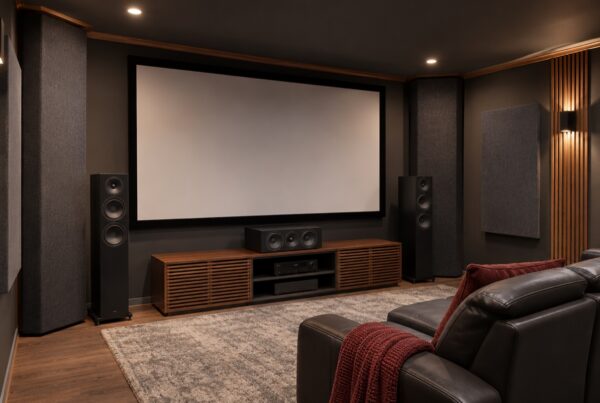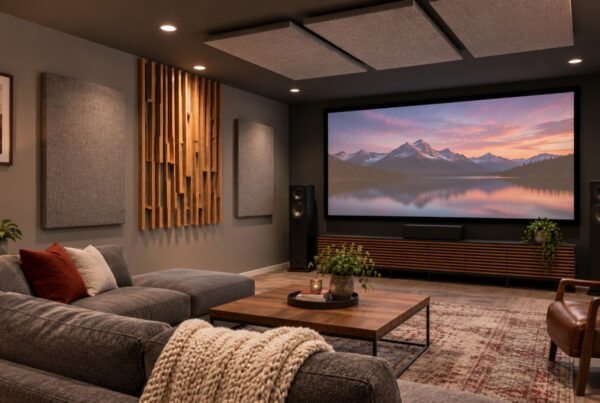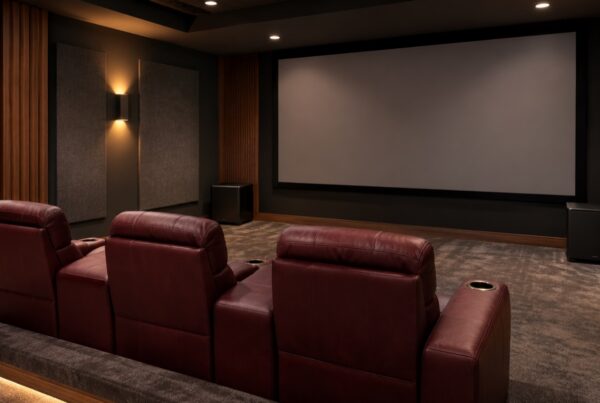


A short room sketch, seating plan, system details, and clear symptom description can make your first acoustics conversation more useful.
Quick Answer
A useful home theater acoustic room analysis starts with the room’s dimensions, layout, seats, speaker and subwoofer locations, surfaces, and the sound problem you want to solve. You do not need to buy measurement equipment before asking a question. Share what you already know, identify the seats that matter, and explain what you hear. Acoustic Fields offers a free initial Room Analysis conversation with Dennis Foley; any later design, product, or installation scope should be confirmed separately.
What “room analysis” should help you clarify
If dialogue is hard to follow, bass changes from seat to seat, or movie sound echoes, it is natural to ask someone to analyze the room. You may be wondering whether to add absorbers, move the subwoofer, change seating, or adjust receiver settings. It can be difficult to tell whether the limiting factor is the room, the equipment, the source, or the way the system is configured.
A room analysis is a structured discussion of those conditions. It begins with the space and the listening goal rather than an automatic shopping list. Acoustic Fields describes its Free Room Analysis as a conversation about the customer’s room and sound concerns. Dennis Foley can discuss analysis and possible recommendations as appropriate. This does not promise that a single call will identify every cause, provide a formal acoustic report, or determine a fixed product quantity. Confirm the scope you need before beginning any later paid design or product work.
This distinction matters when comparing services. Some providers may offer a product consultation, some a system calibration, some a room-design review, and others an installation project. Those are different scopes. Ask what information they need, what deliverables are included, what is not included, and whether any charge applies beyond the initial conversation.
For the broader service and room-first approach, read the Home Theater Acoustic Design and Treatment page. The official CEDIA homeowner home-cinema guidance also treats speaker layout, seating, and acoustic treatment as related room-planning considerations.
What information is useful to gather?
You do not need a perfect drawing. A clear sketch and honest description are more useful than unexplained numbers. Collect what you already have, and mark anything that is uncertain.
Room dimensions and openings
Write down the inside length, width, and ceiling height if you know them. Note doors, windows, alcoves, open hallways, fireplaces, soffits, staircases, and spaces that connect to the theater. These features affect boundaries and limit where speakers, seats, or treatment can go. If dimensions are approximate, label them as approximate rather than rounding them into false precision.
Speaker, subwoofer, and screen positions
Show the screen, left/center/right speakers, surrounds, overhead speakers, and each subwoofer. Note whether any speaker is inside a cabinet, behind a screen, on a shelf, in a wall, or mounted above or below the display. Add the receiver or processor model if it is easy to find, along with the current crossover and room-correction system if you know it.
Seating and the people who use it
Draw every row and seat. Mark the position where the problem is most noticeable and whether the room must work for one central seat, a family row, or multiple rows. Mention if seats are fixed, if a sofa can move, or if sightlines and walkways restrict placement. A plan for one reference chair may differ from a plan intended to serve a group.
Surfaces, finishes, and furnishings
Describe the floor, ceiling, walls, windows, large tables, shelves, curtains, rugs, and seating. Note which walls are shared with bedrooms or neighbors if sound isolation is also a concern. Treatment inside the room and sound transmission through the building are different objectives; mention both if both matter.
The problem in everyday language
Use the words you would use when describing the issue to a friend: “voices get lost,” “bass booms in the back row,” “the room rings after loud effects,” or “the sub sounds weak in the center seat.” Mention whether the issue happens with every title or only some, whether it changes with playback source, and when you first noticed it.
What you do not need to do first
You do not need to purchase acoustic panels before asking whether they suit the room. You do not need to make every wall perfectly symmetrical, buy a calibrated microphone, produce a graph, or replace your receiver just to start a conversation. If you already have measurements or calibration screenshots, they may be useful; if not, describe what you hear and what setup information is readily available.
Do not create a room drawing from a phone photo alone. A photo may show surfaces but will not reliably show dimensions, the seating plan, ceiling height, speaker distances, or how the room connects to other spaces. If the form accepts photos, they can add context, but verify the current form’s upload requirements and only provide images that are appropriate to share.
Also avoid making a long list of settings changes before documenting the current setup. If the receiver has been recalibrated, channels boosted, or the subwoofer moved several times, note what changed and which configuration is active now. A concise record helps keep the discussion focused.
How the conversation can be more productive
Lead with the main goal
State the result you care about most. It may be clearer dialogue at a normal level, bass that changes less between seats, less distracting echo, or a plan for a room that is still under construction. If the room serves multiple purposes, say so. A media room used for movies, sports, music, and conversation may need different trade-offs than a dedicated cinema.
Explain the constraints
List the decisions that cannot easily change: seat locations, screen wall, an open doorway, a shared wall, ceiling height, or a design requirement. Also list the parts that could change, such as a movable sofa, subwoofer position, curtain, or future construction. These constraints help distinguish ideal options from practical ones.
Ask what the next step includes
Ask what information is still missing, whether measurements or additional photos would be useful, and what a proposed next step would cover. If recommendations include products, ask which problem each product is meant to address. Confirm scope, price, shipping, installation availability, timeline, and any written terms directly before committing to further work. Do not assume those details from a free initial discussion.
Keep conclusions proportional to the evidence
A photograph may show a large glass surface but cannot prove that it is the dominant cause of a clarity complaint. A graph may show a peak at one microphone position but not automatically describe every seat. A good conversation should distinguish observed facts from hypotheses and identify what would confirm them.
What may be included in a room conversation?
The first discussion can establish the room’s use, dimensions, surfaces, system layout, and the customer’s priorities. It can help determine whether a concern sounds more like a room issue, speaker-placement issue, subwoofer integration question, source or settings problem, or an overlap. The purpose is to decide what deserves attention first, not to prescribe treatment from one symptom alone.
Depending on the situation, follow-up may involve more detail about construction, measurements, design, products, or a different professional. The exact scope is case-specific. Acoustic Fields provides remote design worldwide and installation in the United States only, based on the current project facts. Product shipping availability is separate and should be confirmed for the customer’s location.
Room treatment changes sound within the listening room. Isolation addresses sound transmission through building assemblies. If the main concern is disturbing neighbors, sound entering from another room, or controlling construction noise, say that directly. A panel intended to absorb reflections inside the theater should not be presented as a soundproofing solution.
Why the listening goal belongs beside the measurements
Two theaters with similar dimensions can have different priorities. One may need speech to remain clear for listeners spread across a couch. Another may have fixed seating in a dedicated room where the center position matters most. A basement theater may share walls with bedrooms, while a living-room system must preserve an open doorway and everyday furnishings. The physical space and the people using it are part of the analysis question.
Measurements can show a response at the microphone locations and settings used. They do not decide which seat matters, what trade-off is acceptable, or whether a visible absorber fits the household. Explain how you use the room, who sits where, and what cannot change. If you are willing to trade some main-seat performance to support other seats, state that too. Clear priorities make recommendations easier to evaluate.
If a provider proposes a precise result, ask what evidence supports it and how it relates to your room. A calculation or model may be useful, but it depends on input details and assumptions. A measurement may add evidence, but it represents the positions measured. Ask what remains uncertain rather than treating a graph, photo, or room sketch as a full guarantee.
Get ready in ten minutes
- Write the room’s approximate inside dimensions. Mark which measurements are uncertain.
- Draw the screen, seats, speakers, and subwoofers. Include every row and the seat where the problem is most obvious.
- List the room surfaces. Note windows, doors, hard floors, ceiling type, large furniture, and open connections.
- Describe one or two repeatable symptoms. Name the seat and content where they occur.
- Record current system details if handy. Receiver, speaker layout, crossover, and room-correction system can be useful context.
- State the constraint and goal. Explain what can change and what must stay in place.
This is a preparation checklist, not a requirement to collect every measurement before contacting the company. If you do not know the technical terms, plain language is enough to start.
Comparing possible next steps
| Next step | Most useful when | Question to ask |
|---|---|---|
| Receiver setup review | A channel, crossover, delay, or calibration profile may be incorrect | Is the current configuration correct for the system and seat layout? |
| Speaker or subwoofer repositioning | Physical placement can change and symptoms vary by position | Which seats should be checked after the move? |
| Room acoustic treatment | Reflections or decay appear to contribute to the issue | What surface, frequency range, and listening positions are being addressed? |
| Bass response work | Low-frequency behavior varies or rings | Is the goal lower decay, less seat variation, or both? |
| Sound isolation review | Sound travels into or out of the theater | Which transmission paths and construction details are involved? |
| Full room design | The room is planned, being remodeled, or has multiple interacting constraints | What deliverables, exclusions, and later costs are included? |
No one option is automatically right for every room. The goal of preparation is to make the conversation specific enough to compare the next steps.
Frequently asked questions
Is the Acoustic Fields Room Analysis free?
Acoustic Fields describes a free initial Room Analysis conversation. Confirm directly whether any additional work, design, product, or installation scope has a charge.
Do I need professional measurements?
Not to begin the conversation. If you already have repeatable measurements, they may provide useful context. Do not treat a measurement without its microphone position and setup details as a complete diagnosis.
Should I send photographs?
Photographs can help show layout and finishes if the current form permits uploads. They do not replace dimensions or a seating/system sketch. Verify the form’s current requirements and avoid including private details unrelated to the room.
Will an analysis tell me exactly which panels to buy?
Do not assume that from the phrase “room analysis.” Ask what the specific service includes and whether product recommendations or a written design are part of the next step.
Can the conversation address soundproofing?
Mention sound transfer explicitly. Acoustic treatment and isolation address different problems, and building construction can be important when sound transmission is the primary concern.
Is remote help available?
Remote design is available worldwide according to the current project facts. Installation is available in the United States only. Product shipping coverage must be checked separately.
Start with the room you have
You can begin without perfect measurements or a list of products. Gather an approximate plan, mark the seats that matter, describe the sound problem, and note the constraints. Then request a Free Room Analysis and ask what information or next step is appropriate for your specific room.
A short preparation checklist
Before you submit a request, think about the main decision you are trying to make. You may be choosing between a speaker change and room treatment, trying to improve dialogue for a wide seating row, or working out why a subwoofer sounds uneven. One clear priority helps keep the conversation focused. If two goals compete, such as preserving a shared family room while controlling reflections, list both and describe which matters most.
Gather whatever information is readily available: approximate length, width, and height; a sketch or floor plan; photographs that show the screen, speakers, seats, and room openings; and a list of the main equipment. Include changes you have already tried and what happened. If you have measurements, note the tool, microphone position, and system settings. Do not present an app screenshot as a calibrated result unless you know the measurement conditions and limits.
Protect privacy when sharing room photographs. Frame the equipment and layout rather than people, mail, screens, or personal items. Check the current form for upload instructions and only provide information needed to understand the room. The purpose of this preparation is not to make the request perfect. It is to provide enough context to discuss the sound problem and decide what additional information, if any, would be useful.
An initial conversation can help clarify whether the question is primarily acoustic, system-related, construction-related, or a combination. It should not be described as a guarantee of a particular result or as a fixed deliverable beyond the current business facts. Ask what a proposed follow-on service or product includes before agreeing to its scope. That keeps expectations aligned with the actual room and the decisions you need to make.
About Dennis Foley
Dennis Foley is Acoustic Fields’ Chief Acoustics Engineer. He is self-taught, has worked in acoustics since 2006, and designed the company’s acoustic foam. His recommendations start with the room, its dimensions, the sound problem, and the customer’s goals.
Read more about Dennis and Acoustic Fields · Dennis Foley on LinkedIn
Start with your room
Describe the room, the seats that matter, and the sound you want to improve. Dennis can discuss the room and help identify an appropriate next step.